The Italian building portfolio counts 12.4 million residential buildings, of which more than 60% were constructed before 1976, when the first energy conservation law came into effect. Added to the national portfolio are 1.7 million non-residential use buildings. These are the results of the national housing stock report made by the ENEA Department of Energy Efficiency, published in August 2024.
A high percentage of Italy’s national real estate assets were built before the Paris Agreement (2015); consequently, the urgency of integrating sustainability practices into building renovation and operational management has been emphasized. This scenario has introduced a major challenge within the real estate market: guiding existing buildings towards sustainability and energy neutrality practices, while considering the entire life cycle. International protocols such as BREEAM In Use and LEED O+M can lead this transition, providing reliable standards to support infrastructure renewal aligned with ESG principles.
LEED for Existing Buildings: Operations & Maintenance (O+M)
LEED for Operations & Maintenance, developed by the U.S. Green Building Council, is a certification protocol applicable to buildings with a minimum of 12 months of verifiable operational data.
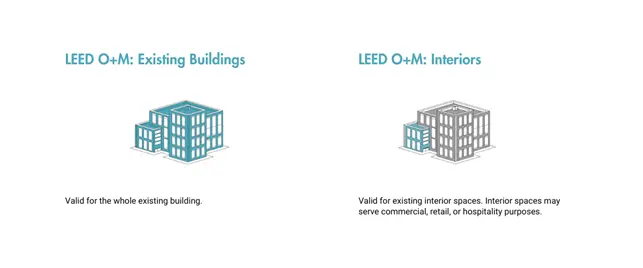
LEED v4.1 O+M beta includes two rating system adaptations:
LEED O+M offers a framework for implementing management practices aimed at minimizing a building’s environmental impact over its lifecycle while optimizing overall maintenance and operational performance. Projects can achieve 4 levels of certification: Certified (40-49 points), Silver (50-59 points), Gold (60-79 points), Platinum (80+ points).
The main Certification’s goals are to:
- Increase the energy performance of the buildings through incremental and measured interventions.
- Define an environmental, economic, and social management process that optimizes existing resources.
The LEED Accredited Professional (LEED AP) supports the project team in navigating certification requirements, providing strategic guidance to select the best practices to optimize performance and achieve the targeted rating. Once obtained, the certificate is valid for three years, with annual performance data required to maintain compliance.
Adopting this holistic approach delivers multiple benefits for existing buildings, including enhanced energy efficiency, improved infrastructure resilience, increased asset value, and reduced environmental impacts.
BREEAM In Use
BREEAM In Use can be a functional Instrument for monitoring and improving the performance of existing assets. The protocol covers the entire operational phase of an asset and is divided into two parts:
- Part 1: Analysis of the performance and physical characteristics of the asset, without assessing its management.
- Part 2: Analysis of the operational management of the building, measuring its efficiency to reduce the environmental impact and improve the comfort and well-being of the occupants.
The two parts can be followed separately. When both are pursued, the resulting scores are integrated into a single certification document. The certificate, once obtained, is valid for 3 years. Subsequent recertification is required to ensure the validity of the achievements and demonstrate ongoing compliance with performance standards over time.
BREEAM defines mandatory baseline requirements for selected credit categories to obtain specific certification levels, thereby ensuring targeted performance outcomes across key environmental impact areas. To achieve the desired results, two key figures support building owners and developers: BREEAM Accredited Professional (AP) and BREEAM Assessor. The BREEAM AP acts as a sustainability advisor to the design and project team, helping to integrate BREEAM requirements into the project’s strategies. It is a strategic role, although not mandatory for the achievement of this protocol. The BREEAM Assessor manages the formal assessment process as an independent verifier, submitting the final assessment report to BRE. It reviews evidence and confirms whether the building meets the BREEAM criteria for certification.
Pursuing this certification pathway enhances asset value and rental potential, supports the transition to a net-zero economy, mitigates environmental impacts, and drives reductions in operational costs.
LEED O+M and BREEAM In Use compared
LEED O+M and BREEAM In Use are both excellent frameworks to optimize the performance of existing assets, promoting sustainability and long-term asset value. Supporting the choice between them often depends on geographic context, stakeholder expectations, and the specific sustainability goals of the asset owner.
These certifications primarily support the building’s maintenance phase, while also offering insights and strategic guidance applicable to renovation projects. Additionally, BREEAM provides recommendations on waste management practices that can be effectively implemented during the building’s end-of-life phase.
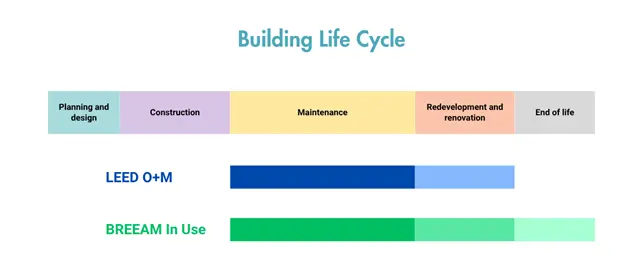
BREEAM In Use, developed by BRE, is widely adopted across Europe and emphasizes a flexible, modular assessment by enabling stakeholders to pursue certification for either one or both of the two distinct assessment components, depending on the scope and operational control of the asset. On the other hand, LEED O+M, managed by the U.S. Green Building Council, is more spread in North America and offers a unified structure.
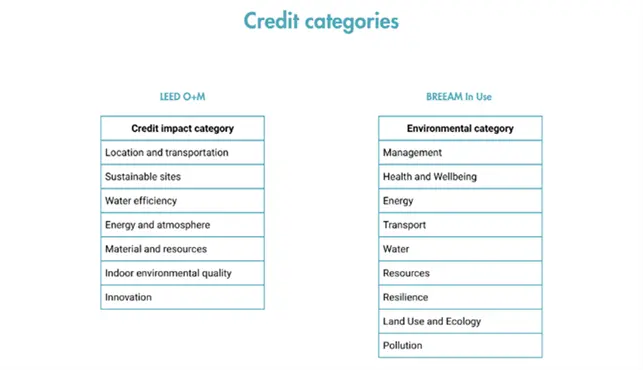
Both Certifications assess buildings across multiple sustainability categories, from energy efficiency to occupant wellbeing. While the structure and terminology of the credit system are different, the main focus often aligns.
LEED promotes continuous performance monitoring through mandatory annual data updates, while both protocols require full recertification every three years. This cyclical verification process supports a data-driven approach to operational excellence and long-term building optimization.
The rating system is slightly different, requiring a customized approach. BREEAM In-Use applies a percentage-based scoring system, where the influence of each category on the final score varies depending on building typology and location. LEED O+M is based on independent credits, which have a fixed point value.
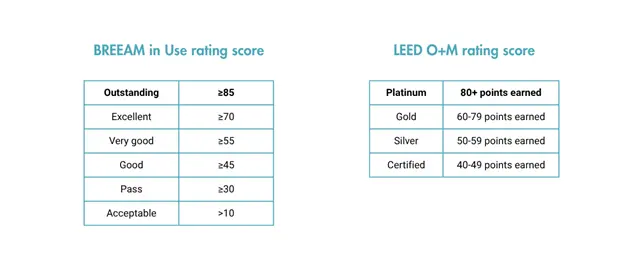
Consequently, BREEAM is more flexible and adaptable to local standards and regulations, while LEED has a global approach with a strong emphasis on performance metrics and documentation.
GET, thanks to its consultancy services and its team of LEED AP, BREEAM AP, and BREEAM Assessor, can support Clients in all stages of certification and recertification. The GET approach consists of:
- Evaluating the existing building’s needs to select the best certification path.
- Providing the best professional figure and training for stakeholders to optimize processes, while selecting the credits to pursue.
- Supporting the project in all certification phases. From data collection and evidence compilation to sustaining asset performance and updating documentation for recertification.
- Accompanying stakeholders in achieving the desired results.
With a portfolio that includes numerous existing building projects and a wealth of consolidated experience, GET can tailor optimal action plans to meet the specific needs of each Client. Integrating best practices across the portfolio’s existing assets can play a pivotal role in accelerating the transition towards a more sustainable future.