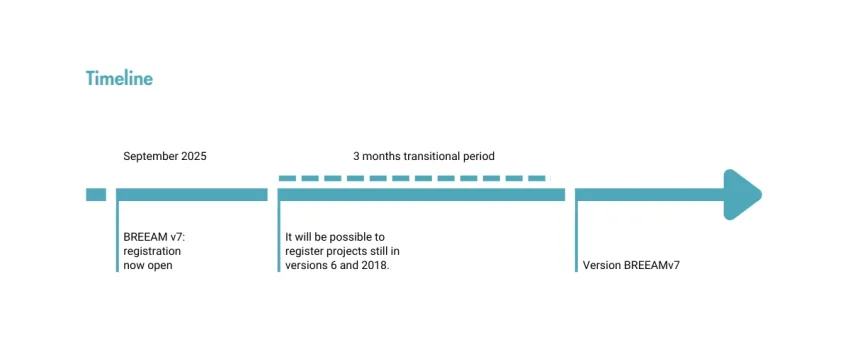
BREEAM v7 NC (New Construction), released in July 2025, strengthens the protocol leadership in aligning building performance with EU regulatory frameworks and ESG priorities. The Directive (EU) 2024/1275 “Case Green” (EPBD – Energy Performance of Buildings Directive), published on May 8, 2024, aims to gradually reduce CO2 emissions from European buildings, heading for complete decarbonization by 2050. Therefore, BREEAM Certification updates are aligned with the latest legislative developments, moving towards net-zero emissions and prioritizing the Life Cycle Assessment (LCA) approach. Registrations open in September 2025; it will be possible to register assets under Version 6 and 2018 until January 27, 2026.
The protocol has also expanded its scope, adding several credits related to areas such as promoting the ecological aspects of projects, improving indoor air quality, and managing lighting for the well-being of occupants.
BREEAMv7 major updates
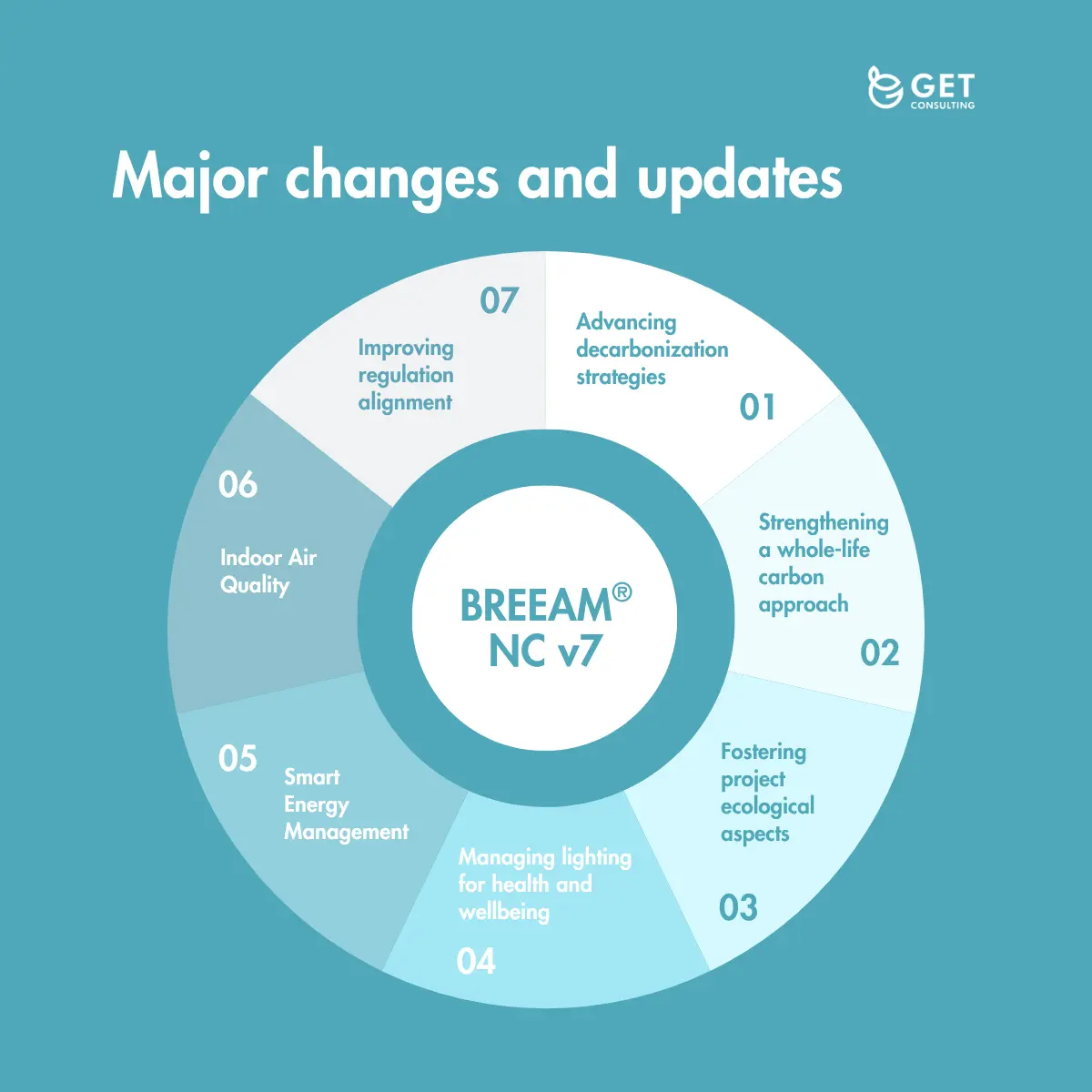
The newest BREEAM standard introduced changes in seven macro categories:
- Advancing decarbonization strategies: New issues are introduced to address both operational performance and embodied carbon, reflecting a strategic shift toward alignment with the BREEAM In-Use framework. In fact, an issue dedicated to energy operational performance has been added: “Ene 02 – Prediction of operational energy and carbon”. Water usage is also accounted for, as the issue“ Wat 05 – Prediction of operational water use” has been implemented.
- Strengthening a whole-life carbon approach: “MAT01 Building life cycle assessment” now includes minimum standards to reach Excellent and Outstanding levels of the certification. It requires LCA and embodied carbon reporting from the concept design stage to post-construction. This enables earlier interventions to reduce carbon impacts.
- Fostering project ecological aspects: The framework dedicated to Land use and ecology has introduced the use of biodiversity net gain tools to quantify ecological change and enhancement, according to available scientific literature. New credits are available, beyond adhering to the “no harm” principle, and demand demonstrable improvements in practice. Ex. “Lue 04 Ecological change and enhancement”, and “Lue 05 Long-term ecological management”.
- Managing lighting for health and well-being: Following recent scientific studies, the credit “Hea 03 Non-visual effects of light” has been added. It evaluates the impact of lighting on the circadian rhythm, prioritizing people’s health and well-being. Furthermore, visual comfort strategies are promoted, such as glare control, daylight, direct sunlight to windows, and views out.
- Smart Energy Management: The new issue “ENE08 Installed controls” recognizes the implementation of controls that enable building systems to respond more efficiently, such as smart controls for lighting, heating, and cooling to improve energy management.
- Indoor Air Quality: edits for indoor air quality have been revised, emphasizing further the importance of this topic in the real estate industry. This requirement is now a ‘minimum standard’, meaning it is mandatory for projects aiming for a ‘very good’ rating or higher.
- Improving regulation alignment: The new version of BREEAM NC has developed specific integrations to enforce the alignment with the EU Taxonomy.
The real estate market is constantly changing, and sustainability certifications both reflect and shape this transformation. BREEAM Certification provides a flexible framework that aligns with the specific design, construction, and operational needs of various asset classes. Its integrated methodology and strong emphasis on the entire life cycle and biodiversity make it particularly suitable for new sites, refurbishments, and the optimization of existing buildings. With the release of the latest version, the protocol becomes even more effective, allowing for a more refined and targeted application across asset types and project phases.
GET support in achieving BREEAM Certification
GET assists real estate stakeholders in identifying the most appropriate sustainability strategies aligned with their project goals. Our approach consists of defining project objectives according to needs, managing stakeholder relationships, supporting Clients to reach process autonomy, and effectively communicating achievements.
GET grazie ai progetti di decarbonizzazione ha risparmiato 3511 tCO2,eq, e il numero è in continua crescita. GET team includes:
- BREEAM Accredited Professional;
- BREEAM Licensed Assessor Company NC, RFO, In Use;
- BREEAM Listed Assessor.
Thanks to its team of specialized professionals, GET guides clients through a customized pathway toward BREEAM certification.
Contact us for more information: info@get-consulting.it