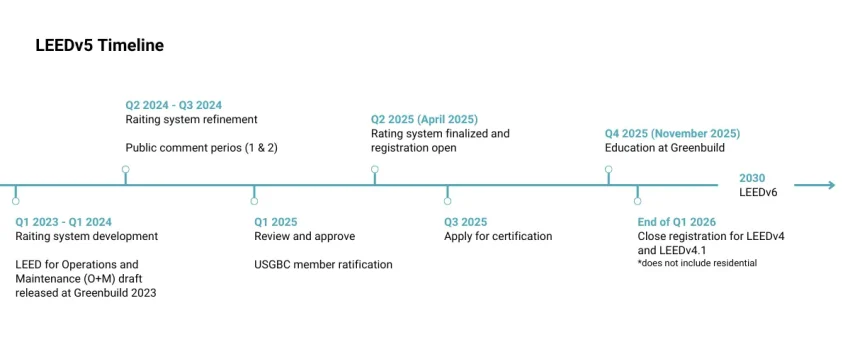
LEED v5 is the updated rating system version finalized in April 2025 of the sustainable certification, and the registrations are now open. The timeline is based on a five-year development cycle that envisions the closing registration for LEEDv4 and LEEDv4.1 in the first quarter of 2026, and the definition of the LEEDv6 framework with a call for integration around 2030.
The ever-changing real estate market needs standards that can evolve to face new challenges such as climate change, global warming, and other critical imperatives. LEEDv5 is about boosting changes for sustainable development and shaping guidelines for today’s needs. The new version comprehends an alternative scorecard’s impact areas, prerequisites, and credits implementation, strategic insights, and stronger alignment with European directives.
LEEDv5: news and updates
Alternative scorecard
LEED v5 scorecard integrates new credits and changes to respond to emerging needs and give more flexibility to projects. Furthermore, an alternative scorecard is proposed to streamline decision-making, and it is based on three impact areas:
- Decarbonization by reducing operational, embodied, refrigerant, and transport-related emissions.
- Quality of life by promoting health, well-being, equity, and resilience for occupants and communities.
- Ecological conservation and restoration by minimizing environmental harm, fostering an approach that allows the built environment to exist harmoniously with nature.
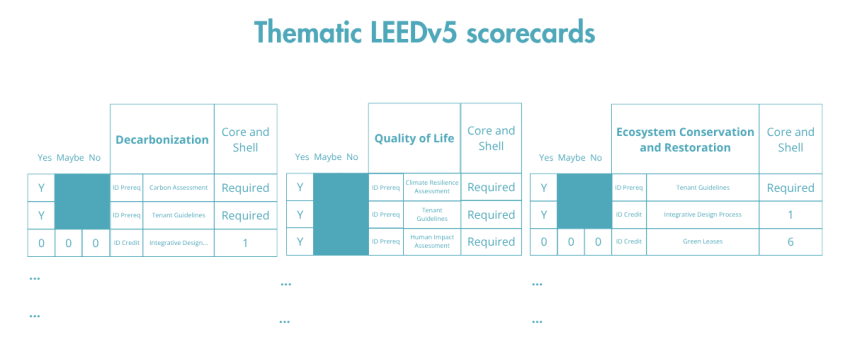
The proposed impact-areas scorecard is intended to divide credits to help developers’ decisions in prioritizing one area more than another, according to the project’s goals, asset type, and site and occupants’ needs.
New prerequisites and credits
The updated version of the certification reflects a stronger commitment to addressing decarbonization and prioritizing occupant requirements. Hence, new prerequisites have been introduced:
- The “Integrative Process, Planning and Assessments (IP)” category requires three new Assessments: Climate Resilience Assessment, which entails identifying at minimum two priority hazards and addressing them through tailored design strategies; Human Impact Assessment is a social equity and health-focused evaluation, it ensure that the project understands the social context and address possible social inequities; finally, the Carbon Assessment, requires a 25-year carbon projection of the project’s emissions from operations, refrigerants and embodied carbon to comprehend and reduce long-term direct and indirect carbon emissions.
- The “Energy and Atmosphere (EA)” category adds the Operational Carbon Projection and Decarbonization Plan, which intends to enable stakeholders to have an overview of how the implemented strategies will impact the project’s long-term operational carbon emission, while ensuring that low-carbon results are being targeted from the beginning of the project.
- The Materials and Resources (MR) category includes the Quantify and Assess Embodied Carbon. This is a prerequisite that aims to make mandatory the quantification of the embodied carbon impacts of the project’s structure, enclosure, and hardscape.
These new prerequisites follow market and environmental needs. Indeed, countering climate change and global warming is increasingly urgent. This imperative can be tackled through effective decarbonization strategies while putting people at the center to prioritize their comfort and designing spaces to live.
Level Platinum achievement
LEED protocol presents 4 certification levels: Certified (40-49 points), Silver (50-59 points), Gold (60-79 points), and Platinum (80+ points). With LEEDv5, to achieve the highest level in addition to obtaining more than 80 points, it is necessary to achieve new minimum requirements for some credits.
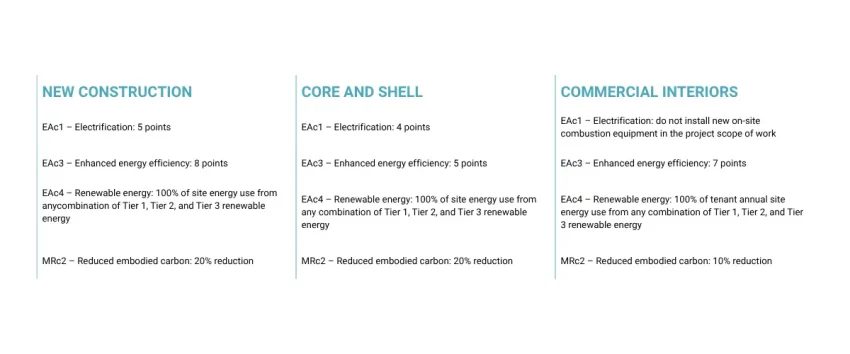
This change in the certification process once again underscores the importance of certain areas in development.
Arc Platform
The new Arc platform is a tool developed by the U.S. Green Building Council that enables stakeholders to collect, manage, and analyze performance, score, and data about their projects and portfolios. It is a dynamic platform that collects key indicators such as energy use, water consumption, waste generation, occupant experience, and carbon emissions. Arc empowers project teams to make data-driven decisions and compare performance.
Alignment with EU Taxonomy
LEEDv5 requirements introduce significant advancements in terms of climate resilience, decarbonization, and occupants’ quality of life, in addition to easing EU Taxonomy compliance. Here are some examples of features that can be aligned:
- Compliance with the Minimum Water Efficiency requirement can be demonstrated using the flow rates defined by the European Taxonomy.
- It is possible to use the Energy Performance Certificate (EPCs), a key indicator used by the EU Taxonomy for assessing buildings’ energy efficiency, as evidence for the LEED prerequisite Enhanced Energy Efficiency. To do this, a 10% reduction from the requirements of a nearly zero energy building in the reference country must be documented.
- The Level(s) approach can be used to demonstrate compliance with the Assess and Quantify Embodied Carbon and Reduce Embodied Carbon credits.
- LCA Analysis has become mandatory, also requested by the EU Taxonomy directive.
- The “Energy and Atmosphere (EA)” section introduces new credits for electrification and reduced peak thermal loads, which will facilitate meeting the EU energy targets for 2030 and NZEB requirements.
- In the Sustainable Sites (SS) category, a new credit has been added to reduce the risk of catastrophic impacts from natural and climate events by designing more resilient buildings and sites. This provides guidelines for implementing strategies that meet the EU Taxonomy’s climate change adaptation principle.
Seeking alignment between the standards provided by sustainability certifications and European directives is a key step in simplifying processes and achieving more immediate results.
GET approach for LEEDv5
Since 2018, GET has supported Clients in achieving their sustainability goals, promoting holistic approaches such as LEED. Through its consulting path, GET:
- Analyzes clients’ needs, assets, and goals to define the most relevant and effective aspects on which to focus. Creates an action plan with guidelines to integrate sustainable best practices, clarifying modalities, timelines, and activities.
- Provides training for stakeholders to empower their workforce and optimize processes.
- Supports during all phases of the project: construction site, obtaining certification, and maintenance.
- Ensures the project achieves the intended goals.
- Supports Clients in managing best practices independently and enhances the results through dedicated communication strategies.
GET counts more than 70 LEED projects certified or under certification in its portfolio, and thanks to its team of professional LEED APs, can create a tailored path towards the new Certification version.