BREEAM Certification (Building Research Establishment Environmental Assessment Method) provides an effective framework for evaluating and improving sustainable performance in buildings. Guidelines are based on established benchmarks and address a wide range of categories from energy to ecology. BREEAM applies to several asset classes, including commercial, residential, industrial, and civil infrastructure buildings.
Originally developed by BRE (Building Research Establishment) in the UK and widely adopted across Europe, BREEAM stands out as a global sustainability standard. Its flexibility to integrate local standards requirements makes it highly adaptable to different international contexts.
One of BREEAM’s key strengths is its integrative and life cycle approach, which extends from the initial project brief and concept design to rigorous monitoring throughout construction and post-construction phases. The protocol puts a strong emphasis on project management, and its on-site monitoring during the construction phase ensures that sustainable design strategies are effectively realized.
Moreover, BREEAM is a practical and time-efficient pathway for European projects to demonstrate compliance with EU Taxonomy requirements, as it provides several criteria aligned with the regulation’s environmental objectives.
BREEAM helps developers and designers create resilient buildings that embody ESG values and pursue Net Zero emissions. It provides an assessment framework to achieve sustainability goals and validate performance with third-party certification.
About BREEAM Certification
BREEAM was the world’s first Sustainability certification for buildings, developed by the Building Research Establishment (BRE) in 1990 in the UK.
BREEAM is organized in several standards, covering different scenarios:
- BREEAM News Construction (NC): it establishes criteria for assessing the sustainability performance of new construction projects.
- BREEAM Refurbishment and fit-out (RFO): its goal is to enhance existing buildings through sustainable renovations, addressing key aspects such as the external envelope, building systems, core and local services, and interior design.
- BREEAM In-use: it provides guidelines for monitoring and managing the sustainability of buildings during their operational life; this standard boosts the improvement of buildings’ performance, increases rental values, and reduces operational costs.
- BREEAM Communities: it aims to support local authorities, planners, developers, and investors in integrating sustainable best practices in new communities and regeneration projects.
- BREEAM Infrastructure: it is a sustainability rating scheme for infrastructure, civil engineering, landscaping, and public realm projects.
BREEAM evaluates sustainability across a series of categories that cover environmental, social, and management aspects. These include:
- Management: promotes sustainable project management practices, with a strong focus on project oversight and stakeholder engagement;
- Materials: reduces the impact of construction materials through design, construction, maintenance, and repair, highlighting responsible sourcing;
- Land Use & Ecology: evaluates how development affects the surrounding ecology and land, and promotes biodiversity on-site.
- Energy: promotes the use of low-carbon technologies, efficient building systems, and renewable energy sources to reduce operational energy demand.
- Water: supports sustainable water use in building and site operation.
- Waste: encourages the sustainable management, minimizing construction and operational waste.
- Pollution: aims to reduce pollution and surface water run-off related to the building’s impacts.
- Transport: promotes sustainable transport and site accessibility.
- Health & Wellbeing: encourages occupants’ health and wellbeing, covering aspects such as indoor air quality, thermal comfort, lighting, …
BREEAM Certification also rewards Innovation and encourages a full life cycle approach to building sustainability. This approach represents a crucial step forward in tackling the whole building’s life performance, from its construction to operation and refurbishment.
A BREEAM project is evaluated with a percentage benchmark that ranges from Unclassified to Outstanding, based on the total score achieved across the previously described categories.
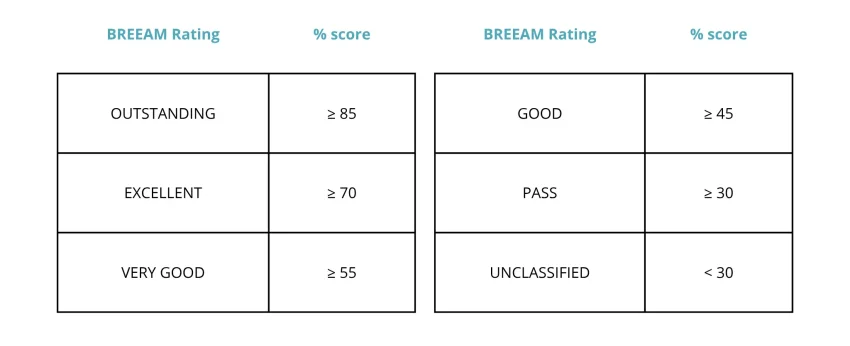
The certification provides valuable insights to drive investors, developers, owners, and operators’ decisions about the ESG impact of their assets. BREEAM rating system promotes an integrated design process, providing a scientific framework to obtain sustainability goals and minimize the impact of the building system.
Why BREEAM Certification
BREEM Certification supports designers and developers in integrating sustainable values into every step of a project. BREEAM guidelines help companies increase their asset values and achieve ESG goals.
The protocol allows the integration of local standards to demonstrate compliance with the assessment criteria. This flexibility makes BREEAM a practical and globally adaptable approach to several climatic and regulatory environments, facilitating alignment with regional legal frameworks.
Additionally, this approach accompanies real estate operators in fulfilling regulations and directives such as the EU Taxonomy. BRE compared the BREEAM criteria with the European Taxonomy requirements to demonstrate compliance in the following areas:
- Climate Change mitigation and adaptation;
- Sustainable use and protection of water resources;
- Transition towards a circular economy;
- Protection and restoration of Biodiversity and ecosystems.
Aligning with the European Taxonomy can bring several benefits for real estate projects, facilitating access to dedicated green financing and investment opportunities, as financial institutions increasingly prioritize taxonomy-aligned investments. At the same time, it improves marketing competitiveness by meeting measurable ESG performance and helps to simplify compliance.
GET Approach
GET offers a client-centered and customized approach to sustainability certification, guiding each project toward the most appropriate protocol based on its specific needs, goals, and context. The team includes BREEAM-accredited qualified professionals (including BREEAM Assessors and BREEAM Accredited Professionals), who bring deep technical expertise to support projects from early design through certification.
GET approach goes beyond technical support thanks to the strong sense of accountability and trust built with Clients. The consultancy services actively engage in solving challenges, answering questions, and driving solutions that align with both certification requirements, available resources, and project-specific sustainability objectives.
BREEAM Certification is a strategic framework for improving building performance, aligning with EU sustainability frameworks, and supporting the transition to a low-carbon economy. To date, GET has advised or certified more than 30 projects across a wide range of asset classes and geographies. This number continues to grow steadily, reflecting the confidence that our clients—developers, investors, and asset managers— place in our ability to translate ESG principles into actionable strategies.